How to Wear a Slip Dress: At Home, at Night and in the Evening
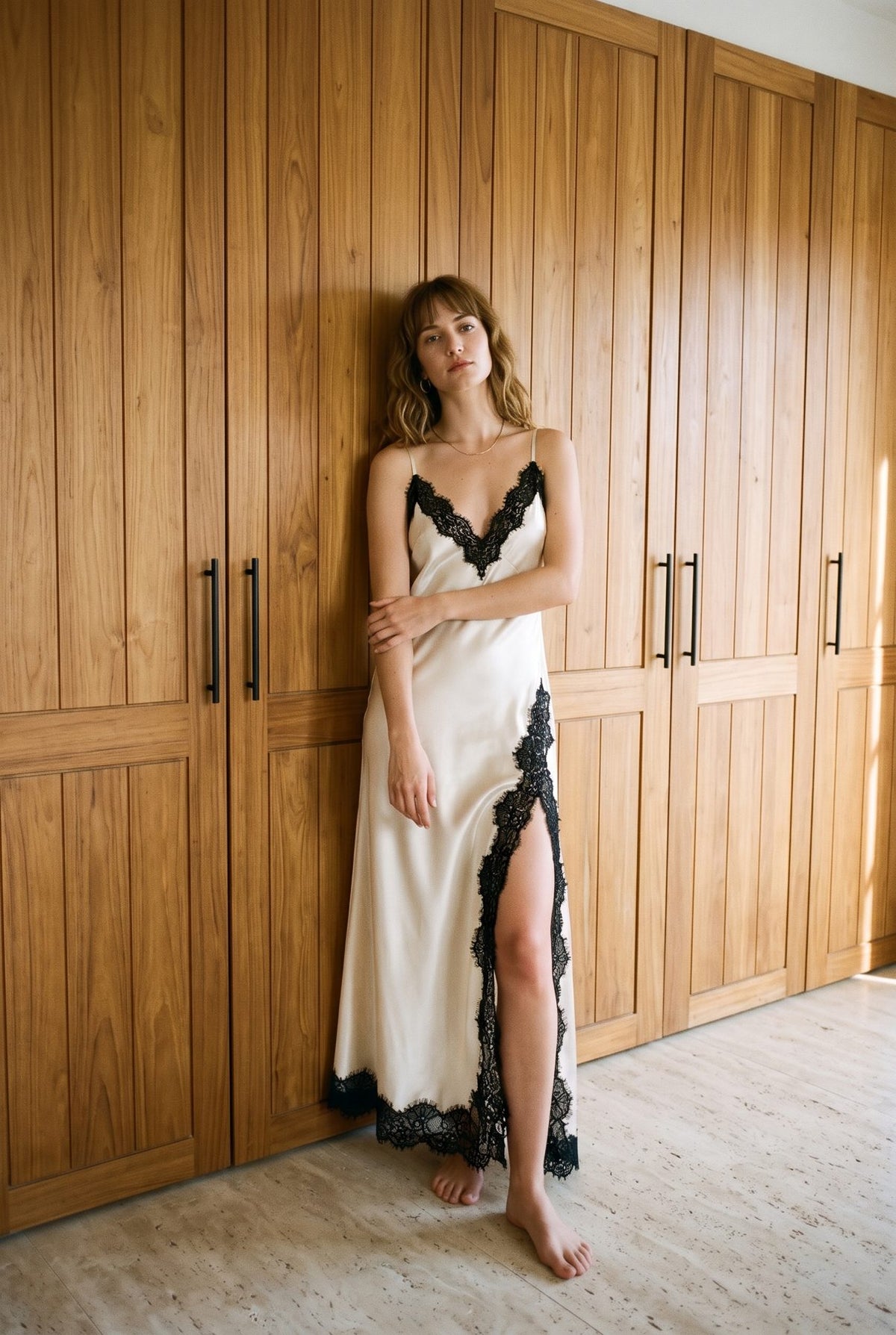
A slip dress works in three places: on its own at home, with a kimono or robe at night, and out in the evening with a jacket or a knit. Two rules apply to all three: wear underwear that leaves no lines, and don't crowd the simplicity of the dress with accessories.
What is a slip dress
It takes its name from the slip, the thin undergarment worn beneath a dress. Over time that undergarment became a dress worn on its own, and one of the defining pieces of the pared-back, minimal style of the '90s. Today a slip dress means a thin-strapped dress with a straight or soft V neckline, in a fluid fabric, usually cut on the bias.
A bias cut means the fabric is cut diagonally to the weave. At that angle the fabric gains slight give and falls following the body. That flow is what separates a slip dress from an ordinary strappy dress. In silk the effect is at its most visible, because silk drapes heavily and fluidly.
The JANESIA Long Slip Dress is the simple form of that definition: silk, bias-cut, ankle-length, with thin bias straps and a single lace detail. It comes in off-white, black, plum, ombré, powder pink and khaki.
What to wear under a slip dress
This is the most asked question. Silk is thin and falls close to the body, so underwear lines show easily.
- Briefs: seamless, laser-cut or with a very fine edge. Lace briefs or thick elastic leave a line under the fabric.
- Colour: not white, but a tone close to your skin. White underwear shows as white under a light dress; a skin-tone shade disappears.
- Bra: with thin straps, a strapless bra or a bandeau. If you wear a bra with straps, make sure they sit exactly under the straps of the dress.
- Underslip: a light-coloured slip dress can look slightly sheer when the light is behind it. A thin skin-tone underslip solves this.
- At home and at night: you need none of this; a slip dress can be worn just like a long nightdress.
At home
At home a slip dress behaves like a long nightdress. When you get up in the morning, put a kimono over it: over the slip dress, next to the coffee. An ankle-length style sits close to the floor, so it looks best barefoot or with thin slippers; chunky house slippers look heavy with a long skirt.
If you are home all day, a belted kimono covers you and, left open, doesn't break the line of the dress. The silk kimono ends below the knee, so the hem of the slip dress shows beneath it; the two lengths layer cleanly.
At night
For sleep, a slip dress doesn't bunch up when you lie down, thanks to its bias cut, and it glides as you move. Still, an ankle-length style can tangle if you turn a lot in bed; if that doesn't suit you, a short nightdress is more practical. On cool nights, put a long robe over it. We compare it with nightdresses in how to choose a silk nightgown.
Evening: from home to out
The real test for a slip dress is going out. With the right layer it goes easily to a dinner or an event.
- Jacket: an oversized, menswear-style blazer. The contrast between a structured shoulder and fluid silk works well.
- Knit: a fine V-neck jumper or cardigan. The easiest layer in autumn.
- Kimono: left open, in the same or a contrasting tone. The softest line for the evening.
- Leather jacket: a tougher look; it pairs well with a black or plum slip dress.
- Shoes: with an ankle-length dress, strappy sandals or simple heels. A heel also keeps the long hem off the floor.
One accessory is enough: a fine necklace or small earrings. The strength of a slip dress is its simplicity; layers of jewellery scatter it. The same logic applies to the bag: small and structured.
By season
Summer: wear the slip dress on its own. Silk is generally a light fibre that absorbs moisture; as a single layer it is comfortable in the heat. If you will be out in daylight for a long time, put a light shawl or a kimono over your shoulders. Direct sun fades the colour of silk over time, which is also why you dry it out of the sun.
Autumn and winter: wear a fine roll-neck jumper or a long-sleeved bodysuit underneath and keep the slip dress on top. A long coat over it, ankle boots on your feet. Sheer tights don't spoil the bias drape; thick, textured tights rub against the silk and pull the skirt up.
Colour and body
A bias cut follows the body. If you would rather not show the line of your hips and stomach, choose a dark colour like black or plum and buy by your hip measurement; if you are right on the line, size up. Light colours like off-white and powder pink reflect more light and show every curve. Ombré carries two tones in a single piece and needs no further styling. We explain measuring step by step in the nightgown size guide.
Common mistakes
- Buying a size too small to look slimmer: the bias cut bunches at the hips and the skirt rides up.
- Underwear with thick elastic and seams: its line shows through the front of the dress.
- Covering the dress with a thick, chunky knit: the flow of the silk disappears; choose a fine knit.
- Too many accessories: a simple dress is stronger with one piece.
- Dragging a long style along the floor in flat shoes: the hem gets dirty and worn; choose a heel or a length that suits your height.
- Spraying perfume onto the dress: it can mark silk.
Care
How long a slip dress lasts is decided by how it is washed. The label comes first; the general rule is inside out, 30°C, by hand or on a delicate cycle in a mesh bag, with gentle detergent. No bleach or fabric softener, no rubbing or wringing. Press the water out by rolling it in a towel.
One detail matters with a bias cut: wet silk is heavy and can lengthen under its own weight on a hanger. That is why drying a slip dress flat, in the shade, is safer. For storage, too, consider folding it loosely in a dust bag rather than leaving it on a wire hanger for long periods. If it needs ironing, iron it inside out, on low heat, while the fabric is slightly damp. Let perfume dry before you put the dress on. All the steps are in our care guide; more styles are in the women's collection.
Frequently asked questions
What do you wear under a slip dress?
Seamless briefs in a tone close to your skin, and a strapless bra or a bandeau. To avoid sheerness in a light-coloured dress, you can add a thin skin-tone underslip.
Can you wear a slip dress as a nightgown?
Yes. With thin straps and a bias cut, it doesn't bunch up when you lie down. Bear in mind that an ankle-length style can tangle in restless sleep; on cool nights, put a robe over it.
How do you wear a slip dress in winter?
A fine roll-neck jumper or a long-sleeved bodysuit underneath, a long coat on top, ankle boots on your feet. Sheer tights don't spoil the drape of the cut.
What shoes go with a slip dress?
Strappy sandals or simple heels for the evening; flat ballet pumps or trainers for the day. With an ankle-length style, a heel keeps the hem off the floor.
Is a silk slip dress see-through?
Light colours can look slightly sheer when the light is behind you. Skin-tone underwear and a thin underslip solve this; dark colours rarely have the problem.