Luxury Loungewear Guide: What Makes It Luxury and How to Choose
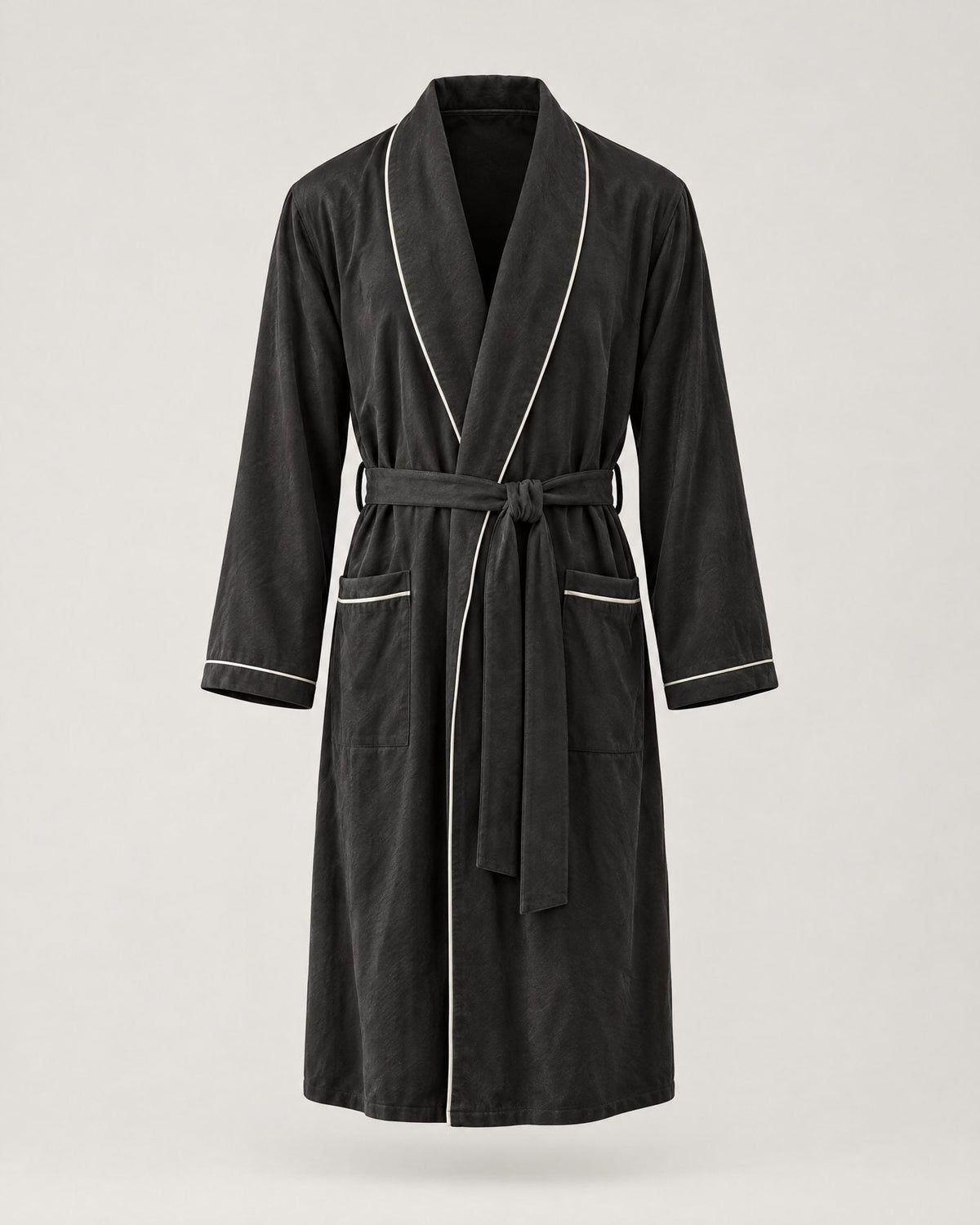
Luxury loungewear is defined not by the price tag but by five things: fibre, weave, cut, seams and care. To tell whether a piece is luxury, turn it inside out, read the label, hold it up to the light and move in it. A few well-made pieces get more wear than many ordinary ones.
Fibre: it all starts with the label
Fibre is what a fabric is made of. Natural fibres such as silk, cotton, linen and wool; fibres made from cellulose such as viscose and modal; synthetics such as polyester and polyamide. In luxury loungewear, what you look for is a natural or naturally derived fibre on the surface that touches the skin.
Silk stands apart in this list. In general it is a light fibre with a smooth surface; it absorbs moisture and helps balance temperature, which is why it can be worn in every season. Note that “satin” is not a fibre name but a weave. Polyester satin shines like silk but does not behave the same way. We explain the difference in our silk vs satin guide.
Silk is not the only luxury fibre. A good cotton sateen or modal is also comfortable and long-lasting in loungewear; the difference is in silk's drape and light. Know this too: on a silk piece, details such as lace or feathers are usually a separate material and do not count as silk.
Weave and weight
The same fibre woven differently becomes a completely different fabric. In silk nightwear, the most common weaves are charmeuse (one side lustrous, the other matt, fluid), crepe de chine (more matt, slightly grainy, more substantial) and twill (diagonal weave, sturdier). All the types are in our types of silk fabric guide.
Silk weight is measured in momme. As momme rises, the fabric generally becomes denser, less sheer and more durable. In nightwear, 16 to 25 momme is common. But momme alone does not define luxury; weave and workmanship matter just as much. More on this: what is momme.
Lustre gives a clue too. Silk reflects light softly and with depth; ordinary synthetic satin has a flat, glassy shine.
Cut: how the fabric falls
Luxury shows most in the cut. In a bias cut, the pattern is laid on the fabric at a 45-degree angle. The fabric gives slightly in this direction and flows along the body's line; this is where the typical fall of a long slip dress comes from. A bias cut uses more fabric than a straight cut and needs more care in sewing, which is why it is rarer in fast production. Size matters more in a bias cut too; the fabric sits close to the body, so always check the size chart.
The second thing to look at in a cut is proportion. The length of a robe, the width of the cuff, the position of the belt. On the Shawl-Collar Robe, the knee length and full-length sleeves make the piece both relaxed and neat. Too loose a cut looks lazy, too tight a cut looks cramped; a good pattern sits between the two. In pyjamas, room to move matters as well: woven silk generally does not stretch, so there should be comfortable ease at the shoulders and hips.
Seams and the inside
Turn a piece inside out. The inside tells you how much care the maker took where no one looks. A piece that is as neat inside as outside is a piece that lasts.
- Are the seam allowances enclosed? On fine fabric, seams where the edge is folded in and enclosed (such as French seams) stop fraying and leave no mark on the skin. Thick, exposed overlocking is faster but can feel stiff on silk.
- Is the stitching straight and even? Stitching that wanders, puckers or ripples is noticed at once on a slippery fabric like silk.
- How are the edges finished? A neckline and straps finished with bias binding strengthen the edge and look clean, like a line drawn from the outside.
- Belt and strap attachments. These are the points pulled the most. The joins should be strong and neat.
Detail: less, but right
In luxury loungewear, the number of details goes down and the work each detail does goes up. Tone-on-tone lace at the bust, fine piping at the collar, a single row of lace at the cuff. A contrast detail can work too, as long as it is single and small. On the Long Lace Nightdress, the lace sits at the bust, tone on tone; it enriches the piece without crowding it.
The finer and more even the piping and lace, the more carefully made the piece looks; thick, wavy binding cheapens it at first glance. Buttons and buttonholes give clues too: if the buttonhole is dense and clean and the button passes through without puckering the fabric, the workmanship is good. Some things do not make luxury: large logo prints, plastic shine, accessories added to every corner. They look expensive from a distance and ordinary up close.
Lace quality is a topic of its own: motifs that match at the seam, an edge that is cleanly finished, a side against the skin that is not harsh. For lace types, see our types of lace guide.
Colour: a quiet palette
Luxury loungewear does not shout. Powder pink, ecru, off-white, khaki, black, anthracite, plum, burgundy: all quiet but deep tones. The colour should be even across the whole fabric; a shift in tone around seams or in folds can point to weak dyeing. In silk, colour changes with light: the same khaki can look closer to green in daylight and to brown in evening light.
Care and presentation
A luxury piece comes with its care. Silk whose care is not explained wears out quickly after the wrong wash. At JANESIA, every order arrives in the ritual wrap: a printed box, a dust bag, a seal and a care card. The dust bag is not decoration; it is part of storing silk away from light and dust.
The basic rule is short: the label comes first. Wash inside out, at 30°C, by hand or in a mesh bag on a delicate cycle, with a mild detergent. No bleach or fabric softener, no wringing. Dry in the shade, never in a tumble dryer. Iron on the reverse at low heat. Store on a hanger or loosely folded, in a breathable wardrobe out of the sun. The details are on the care page.
A one-minute check when buying
- Read the label: does it name the fibre, does it give care instructions?
- Turn it inside out: are the seam allowances enclosed, are thread ends hanging?
- Hold it to the light: is the colour the same everywhere, is the fabric too sheer?
- Hold it on a hanger: does the fabric fall straight and with weight, or do the edges ripple?
- Pull gently at the seams: does a seam open, or does the fabric slide along the stitch line?
- Check the details: do the lace motifs match, does the piping turn evenly, is the belt loop secure?
Few pieces, lots of wear
A luxury loungewear wardrobe is never crowded. A few good pieces worn together get more use than ten ordinary ones. Here, luxury is not in the number of pieces but in how many times a week each one is worn. A starting point:
Four pieces for women
- Long Slip Dress: a nightdress at night, a dress at dinner.
- Kimono or Lace Robe: over the slip dress and the pyjamas. The kimono falls below the knee, the robe is long.
- Lace Pyjama Set: shirt and long trousers for winter and days with guests.
- Camisole + Shorts: for summer nights.
Few pieces call for colour discipline. Keep your loungewear to two main colours and one accent; khaki and powder pink, for example. All four of these pieces come in those colours, and each one works with the others.
Three pieces for men
The men's Lounge Set · 3 Pieces is already built on this logic: shawl-collar robe, shorts and trousers. The robe for every season, the shorts for summer, the trousers for winter. You can take the set in one colour, or add trousers and shorts in other colours; black and off-white as main colours, burgundy as the accent. Everything is in the men's collection.
Frequently asked questions
What is luxury loungewear?
Loungewear and nightwear made to last through its fibre, weave, cut and seams. It is defined not by price or logo but by how the fabric falls, how the inside is finished and how the care is explained.
What fabric are luxury pyjamas made of?
Silk is the most common; charmeuse, crepe de chine and twill are the usual silk weaves in nightwear. A good cotton sateen or modal is also a comfortable, long-lasting option.
Silk or cotton loungewear?
Silk is lighter, more fluid and more lustrous; in general it absorbs moisture and helps balance temperature. Cotton is easier to care for and stands up better to machine washing. Choose silk for drape and feel, cotton for easy care.
What does bias cut mean?
It means the pattern is laid on the fabric at a 45-degree angle. The fabric gives slightly in this direction and flows along the body's line. The fluid fall of a slip dress usually comes from the bias cut.
How do you wash luxury loungewear?
Check the label first. For silk, the general rule is inside out, 30°C, by hand or in a mesh bag on a delicate cycle, with a mild detergent; no bleach or fabric softener. Dry in the shade and iron on the reverse at low heat.