Robe or Kimono? The Difference and Which to Choose
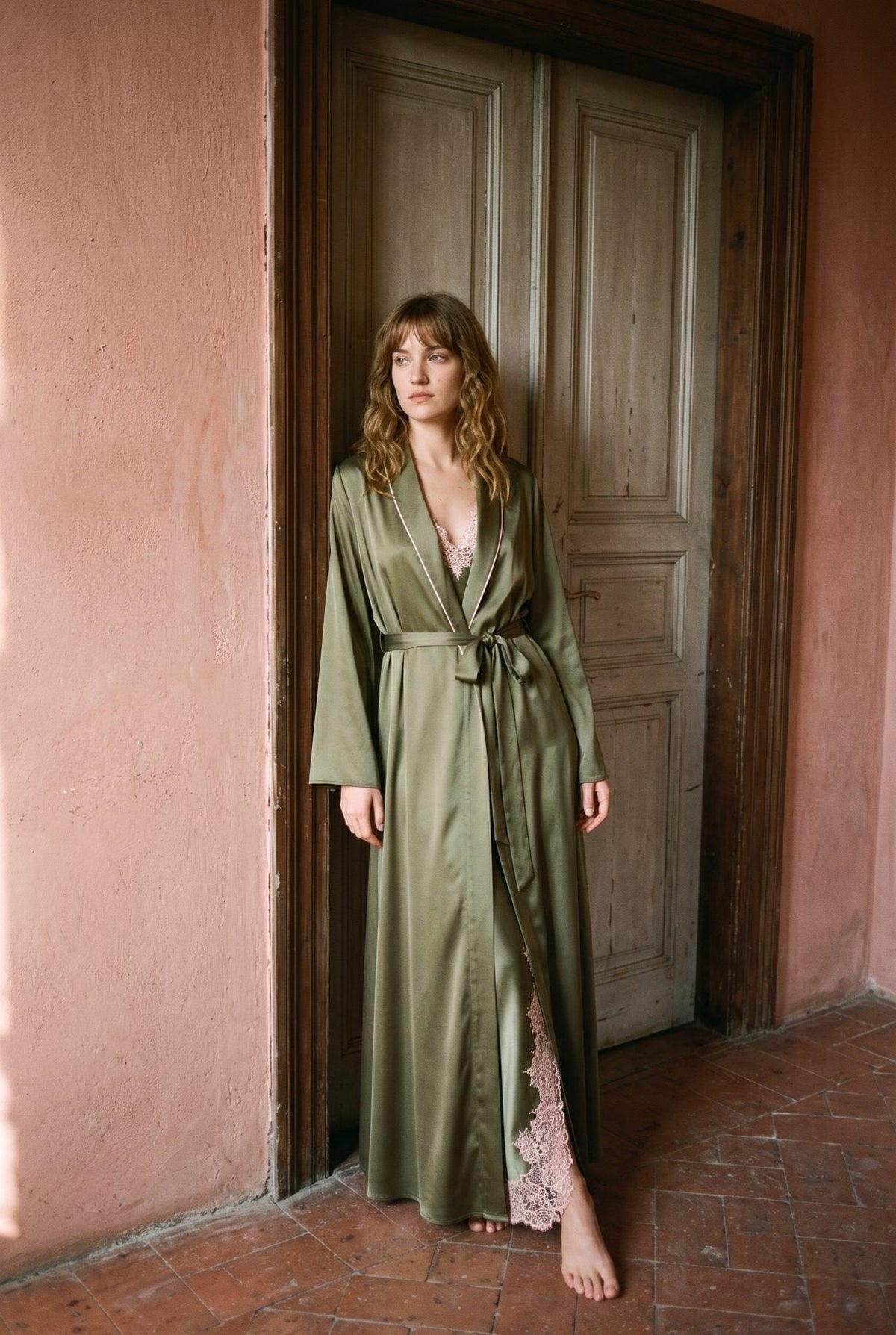
A robe and a kimono are both worn over a nightdress or pyjamas and close with a belt. The difference is in the cut: a kimono has a flat band collar, wide sleeves and a loose, T-shaped body; a robe is usually longer, with sleeves closer to the wrist and a shawl collar or no collar at all. A kimono behaves like a light layer, a robe more like a complete cover-up.
Where the words come from
In Japanese, kimono roughly means "a thing to wear". A traditional kimono is sewn from straight panels into a T shape, wraps over at the front and ties with a wide sash. The kimono we wear at home is a simplified version of that cut: the same T line, the same band collar running down to the hem, but much lighter and more practical.
A robe, or dressing gown, is what you put on when you get out of bed and wear around the house. Unlike a bathrobe, it isn't made of towelling but of silk, cotton, velvet or wool, and you wear it to be dressed, not to dry off.
The differences at a glance
| Kimono | Robe | |
|---|---|---|
| Collar | Flat band collar running to the hem | Shawl collar, collarless or band collar |
| Sleeve | Wide, straight cut, usually a dropped shoulder | Narrower, close to the wrist, set-in sleeve |
| Body | T-shaped, loose | Closer to the body, waist defined by the belt |
| Length | Hip level to below the knee | Knee to ankle |
| Details | Minimal; belt and band collar | Patch pockets, piping, cuff details are common |
| Best for | A light layer, warm weather, styling | A cool home, wearing for hours, matching sets |
This table is a general frame; shops often use the two words interchangeably. You tell what a piece is from its collar and sleeve cut, not its name.
When to choose a kimono
Because a kimono hangs loose, it is easy to put on and take off. In summer you throw it over a short nightdress or a camisole set; the wide sleeves let air in as you move. It also travels beyond the house: over a slip dress it works like a light jacket, and left open it lengthens the line.
The JANESIA silk kimono falls below the knee and ties with a belt; it comes in khaki, powder pink and black. With its loose cut it comes in two size ranges, S/M and L/XL, which makes it an easy gift when you don't know the size.
When to choose a robe
A robe covers more. With sleeves close to the wrist and usually a longer length, it stays on through morning coffee and evening reading in a cool home. A robe in the same fabric and colour as the nightdress feels like a set. On special days, in a trousseau and in photos, that unity shows.
The Lace Robe is long and belted, with lace at the cuffs; it comes in the same five colours as the Long Lace Nightdress, so the two make a set. For men, the Shawl-Collar Robe is knee-length with wrist-length sleeves and two patch pockets; the collar, cuffs and pocket openings are edged with fine piping. Every style is in the robes and kimonos collection.
By height and body shape
If you are petite, a piece that ends at or just below the knee keeps your proportions. An ankle-length robe can swamp a petite frame; tying the belt at the narrowest point of your waist balances it. If you are tall, an ankle-length robe and a below-the-knee kimono are both easy to carry.
The shoulder line affects the choice too. The dropped shoulder of a kimono softens broad shoulders. A shawl collar and set-in sleeves give structure to a narrow-shouldered frame. For a fuller bust, a shawl collar covers evenly and forms a clean V with the belt.
Styling: matching what is underneath
- Long nightdress and long robe: same colour, same fabric. The most complete pairing; the hem of the robe sits slightly below the nightdress or lines up with it.
- Short nightdress or camisole set and a kimono: the kimono completes the short piece, and its below-the-knee length balances it.
- Slip dress and kimono: between home and evening. Leave the kimono open or tie the belt loosely. More in how to wear a slip dress.
- Pyjama set and robe: for winter. The shirt collar shows beneath the shawl collar.
For colour there are two routes: fully tone-on-tone, or one dark and one light. A powder pink robe over a powder pink nightdress looks calm. A black kimono over an ecru nightdress gives a more graphic contrast.
Fabric and season
Both come in silk, cotton or velvet. In silk, a robe or a kimono stays light; worn with a silk nightdress, the two smooth surfaces glide over each other without catching. Cotton and towelling are more absorbent and better suited to after a bath. Don't put a silk piece on wet skin; it can leave water marks.
Silk is generally a thin layer that helps balance temperature, but it won't keep you as warm as a thick winter robe. In a very cool home, add long-sleeved pyjamas underneath. We cover layering in are silk pyjamas warm enough for winter.
For gifts and the trousseau
The biggest uncertainty with a gift is size. Kimonos and robes, being belted and loosely cut, are much more forgiving than nightdresses; that is why the first piece of loungewear bought without knowing the size is usually one of them. The broad size ranges of a kimono make it easier still. In colour, a quiet tone like black or powder pink pairs more easily with someone else's wardrobe.
In the çeyiz, the trousseau a Turkish bride prepares, the robe is usually planned together with the nightdress. A nightdress and robe in the same colour and fabric look complete during the bridal preparations and in photos. Choosing both together, rather than completing the set later, removes the risk of a colour mismatch. We cover this in what is a bridal robe; box and handwritten note options are on the gift page.
Which suits you: a quick decision
- For summer, over short pieces, sometimes outside: kimono.
- A cool home, wearing for hours, a set with your nightdress: robe.
- A gift without knowing the size: kimono; broad size ranges widen the margin for error.
- A trousseau or special-day photos: a robe in the same colour as the nightdress.
- For men: a shawl-collar robe; knee length and pockets make everyday use easy.
If you are considering both, start with the season you spend most time at home. Care is the same for both: inside out, 30°C, by hand or on a delicate cycle in a mesh bag, dry in the shade. Details are in our care guide.
Frequently asked questions
Is a kimono the same as a robe?
No, though the words are often used interchangeably. A kimono is an outer layer with a flat band collar, wide sleeves and a T-shaped body. A robe is longer, with narrower sleeves closer to the wrist and a shawl collar or no collar.
Can you wear a kimono outside?
Yes. A light silk kimono can be worn like a light jacket over a slip dress, or over a plain T-shirt and trousers. Left open it lengthens the line; a loosely tied belt defines the waist.
How long should a robe be?
It depends on use. Knee length is the most practical; it doesn't get in the way on the stairs or in the kitchen. If you are pairing it with a long nightdress, the robe should also reach near the ankle; if you are petite, below the knee looks more balanced.
Can you wear a silk robe after a shower?
Dry off first. Silk absorbs moisture, but contact with wet skin can leave water marks. A towelling bathrobe after the shower, then a silk robe once you are dry, is the better order.
What size kimono should I get?
Because a kimono is loosely cut, it is usually sold in broad size ranges. The JANESIA kimono comes in S/M and L/XL; choose by bust and shoulder width, and if you are between ranges, take the larger.